Feeds:
Posts
Comments

Archive for the ‘books’ Category

Rabbis, Incompetent and Feisty

To the always already caffeine dependent,

The nominations are in! No, not for the Oscars or the Golden Globes, but the awards we’ve all been waiting for: The Independent Spirit Awards. Let the office pools begin! In all honesty, while I tired of televised award ceremonies long ago, the ISA’s—or is it the Indies? the Spirits?—past winners are oddly in line with the types of films I tend to enjoy: artsy, clever to a fault, vaguely alienating. You know, fun. Which is why I’m pleased, at least, to see that Joel and Ethan Coen’s latest, A Serious Man, will receive the Robert Altman Award, in recognition of its director, casting director, and acting ensemble.

If you haven’t seen it yet (and why not?), the film follows the steep downward spiral of Larry Gopnik, a mild-mannered physics professors in 1960s Minnesota. Besides the generous use of Jefferson Airplane and perfect set design, I found particularly uncanny its portrayal of suburban Judaism at the dawn of the counterculture, with its enthusiastic though largely out-of-touch rabbis and a general hollowness in the face of genuine spiritual searching. I wish I could say such anomie no longer characterized many synagogues today, but alas, the empty sermons felt eerily reminiscent of the Long Island synagogue I attended as a child, and some of the services I’ve attended as an adult.

The search for meaningful spiritual connection is, of course, nothing new among American Jews. Just take a case in point from the late nineteenth century (how do you like that segue?!): the  archives of Isaac Mayer Wise on the American Jewish Archives site. Unveiled earlier this year, the collection showcases essays, books, photographs, and letters of the Bohemian-born Rabbi Wise, who was one of the founding leaders of American Reform Judaism. And he wasn’t a bad dresser either.

Wise seemed particularly concerned about the place of Jews within a Christian nation–an issue he strikes on most clearly in his lecture “The Wandering Jew.” But Wise also weighed in on larger political debates, like temperance, arguing that a pint of beer was hardly a sin. And he wrote some passionate love letters to his wife. In one from 1876, he wrote,  “Now I have my regular hours in which to write to you. I write to you in the afternoon and immediately after dinner. This hour ought to remain kiss hour in our memories not including the other kisstime—right after dinner… If you laugh at me, Selma, for being so stingy about the kissing I shall laugh at you for being so much in love that you wrote eight ardent loveletters in a week… Your letters, my wonderful Selma, are really perfect. They show the highness of your soul and the nobleness of your heart.” Read the full translation here.

Sagely yours,

Stephen
Read Full Post »

Dear preemptive vacationers,

I realize there’s been a lot of food in these dispatches lately, perhaps in subconscious anticipation of Thanksgiving this Thursday. I don’t know about you, but when I think about Thanksgiving (or Turkey Day, as I’ve heard it called), I think about sweet potatoes with marshmallows, fresh roasted turkey, grandmotherly love—and that’s just the Garfield Thanksgiving special.This year my brother and sister-in-law are hosting, and rather than bake a pumpkin pie, I figured I’d bring something far more nutritious and satisfying: cultural ephemera! Even my nephew, who hasn’t started teething, can digest that!

Even in 1898, Americans had discovered the fine art of historical reenactment. The photograph below, from the Memorial Hall Museum Online, shows four women dressed in colonial garb making “Thanksgiving Pies.” The image was created for Home Life in Colonial Days by Alice Morse Earle, usually remembered for reviving interest in the colonial period.

If you’re unsure what to prepare for your own Thanksgiving feast, then best consult the amazing collection of cookbooks and home economics among Virginia Tech’s rare and digitized books. Why not take a page from Ida Follett’s Table Decorations and Delicacies: a Complete Hand-book for the Hostess, and place a stuffed turkey at the center of the table (and illustrated turkeys at the center of your plates!). Honestly, it’s only slighty tackier than the Thanksgiving “tablescape” offered by the Food Network’s Sandra Lee.

You can also search USC’s L.A. Examiner negatives archive for some truly awe-inspiring photographs from the years of 1950s abundance, like the ones below.

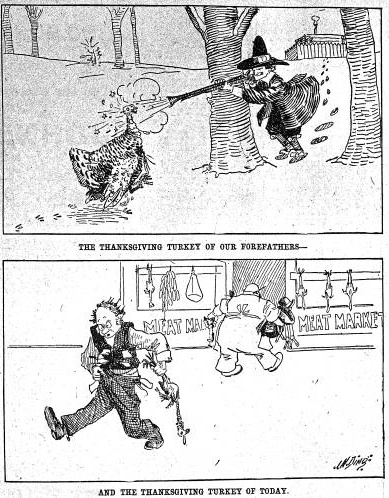
And last but not least, I’ve pointed you, dear readers, to the J.N. “Ding” Darling cartoon archive at U of Iowa, but not his Thanksgiving panels. Here’s one of my favorites, “The Thanksgiving turkey of our forefathers – and the Thanksgiving turkey of today.”

With thanks to you, readers,

Stephen

Read Full Post »

Dear last-minutes-before-class loiterers,

Like some of you, I’m just old enough to remember the days of ye olde card catalog—when finding a book required more than a quick Google search. No, the dedicated researcher pulled out drawer after wooden drawer—even stacked them in a dangerous Jenga-like tower—and then flipped endlessly to find the perfect book for your fourth grade report on farming.

I can’t pretend I’m entirely nostalgic for the pre-digital era. I still remember my feeling of awe the first time a computer card catalog showed up in my elementary school library. But I do miss the aura of those wooden drawers, which lent the library a heimish feel. And what about those tiny index cards, which seemed almost magical, as though they hadn’t been typed and inserted but just appeared mysteriously when a new book hit the shelf.

The University of Iowa library found a rather delightful way to recycle their card catalogs, not by turning the wooden bureau itself into a makeshift liquor cabinet (though that is a good idea, isn’t it?), but by asking artists to transform the cards into creative works. The cARTalog project includes such highlights as Michelle Souliere’s subtly dark “Poe, Heavily Annotated” (below) and Fabio Sassi’s witty take on Plato.

Poe Heavily Annotated

Other projects have a distinctly environmental edge, like Marlene Scott Russum’s “Charta Catalogus” (below) and Corey Gerlach’s commentary on “Genetic Vulnerabilty of Major Crops.”

Charta Catalogus

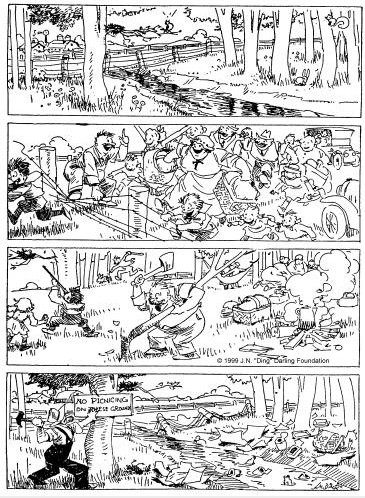
Speaking of the environment, while you’re on U of Iowa’s digital library site, be sure to check out some of their other collections, including the digital archive of J.D. “Ding” Darling’s cartoons, many of them conservation-themed. In the 1923 image below, titled “Look out! Here come the nature lovers,” Darling reveals the environmental risks of picnicking. Look out here come the nature lovers

Until next time.

Ecologically yours,

Stephen

Read Full Post »

Dear idling experts,

I’ve lived in Massachusetts for three Halloweens now, counting tomorrow, but I’ve yet  to trek to Salem for their ghoulish festivities. From what I hear, they’re a real hoot—if by hoot, you mean a gross misappropriation of the past. Why worry about Puritans persecuting each other when you can visit  a psychic fair?

For a more historical Halloween experience, check out Cornell’s Witchcraft Collection. Sure, you know the story of John Proctor—but what about the Salem dogs that were put to death, for afflicting people with their stares? Or read Increase Mather’s account too, whether the original manuscript or transcribed.

If that’s not spooky enough, take a look at these adorable/terrifying trick-or-treaters in 1965 Greenville, from East Carolina U’s Daily Reflector collection.

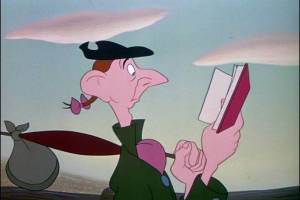
legendofsleepyhollowBut the best way to get into the Hollow’s Eve spirit for the die-hard Americanist: watching Disney’s still charming adaptation of Washington Irving’s”Legend of Sleepy Hollow,” with tunes sung by Bing Crosby himself. Tim Burton has nothing on this! Watch one of the highlights, “The Headless Horseman,” here.

Bewitchingly yours,

Stephen

Read Full Post »

Dear power nappers,

On Saturday, David and I headed to the vertical Long Island—that is, New Jersey—to meet my new nephew Sammy, a beautiful little boy who has the eyes of his father (my brother), the ears of his mother, and the sleep patterns of a lazy-scholar-to-be: he spent the majority of our visit napping, waking up only to say hello and to eat.

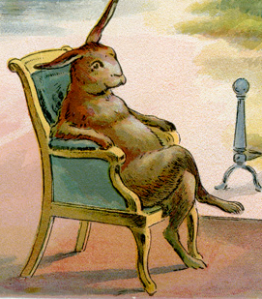
Detail from Baby's Rhyme BookSo in honor of Sammy, I bring you today the marvelous Baldwin Library of Children’s Literature, courtesy of the University of Florida. The digital archive includes over 5000 books from the early 1700s to the present, including Baby’s Rhyme Book, from 1886, which starts out with the rousing tale “Kit-ty’s Day”: “9 A.M. Hungry, and tired of waiting for those people who will not come down; so I am obliged to help myself. Cream not so thick as it ought to be, but I do not complain.” Though if any book deserves a reissue, it’s the handsomely illustrated Jolly Animal ABC (1888), which features a fiddling pig and a truly relaxed hare.

pighare

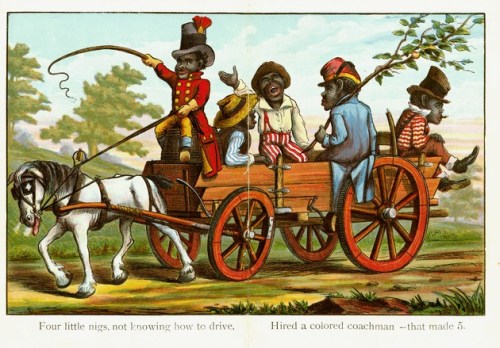
Far less kid-friendly today is the 1876 book Simple Addition by a Little Nigger, published in New York, which follows an ever-increasing number of black children as they get into trouble.

Simple Addition

For Sammy’s sake, when choosing children’s books for bedtime, I’ll stick to clever fauna, like this finely-dressed specimen from Palmer Cox’s Funny Animals.

Fox

Sleep well little ones!

Sartorially yours,

Stephen

Read Full Post »

To my fellow worshippers of Hypnos,

Bruce Handy’s recent New York Times essay on why he disliked Maurice Sendak’s Where the Wild Things Are as a kid—but not as an adult—has got me thinking a little about what boys read and why. Consider, for instance, Stanford’s wonderful collection of turn-of-the century dime novels and story papers. You can view literally hundreds of covers, with bold, exciting illustrations like this one (left) from Young Rough Riders Weekly. Way to ride through that Native American encampment! Or what about Frank Leslie’s Boys of America (right). Get him with your tusk, Dumbo!

Rough Riders WeeklyBoys of America

You can also mull over the gender dynamics of such stories like “The Queen of the Bullfighters” and “A Girl Crusoe” (pictured below).

girl crusoe

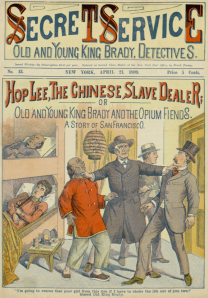
And check out the full text of the series Secret Service, about a pair of detectives who make frequent forays into Chinatown. In the story pictured below, the Brady bunch break up an opium ring—think of it as an early 20th century version of The Wire, you know for kids.

Hop

Boyishly yours,

Stephen

Read Full Post »

Dear siesta sympathizers,

Those of you following the Lazy Scholar blog may be asking yourself, “Who is that handsome devil on the homepage?” No, dear readers, it’s not a portrait of yours truly, but rather the official Lazy Scholar mascot—known in his own time and place as Paul Nebeker Bogart. The mixed-media caricature comes from a clever 1905 portfolio depicting famous businessmen from that center of international commerce: Terre Haute, Indiana. Bogart himself was a locally-born lawyer (and later a banker)–but not one afraid of distraction. As the authors recounted, “Law books do not furnish all of Mr. Bogart’s reading. He enjoys literature of another kind occasionally, and frequently looks up authorities other than law, when ‘down’ for a paper before the Literary Club.”

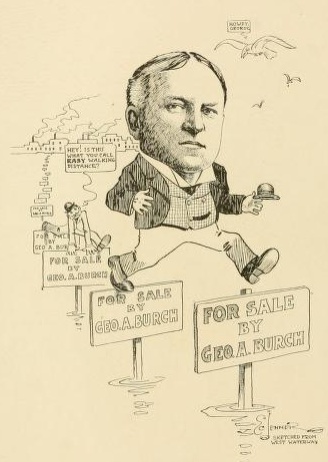
I stumbled across the book while digging around the Internet Archive’s ample Americana collection, which includes a surprising number of similar books, practically a genre of illustrated guides to your local chamber of commerce, apparently quite popular at the beginning of the 20th century. So whether you’re looking for a realtor in Seattle (pictured below), a banker in Indianapolis, an opera treasurer in L.A., a grocer in Fort Wayne, or a New Haven professor—should you find yourself in the early 1900s, you’ll know where to go!

realtor

My favorite, though, for sheer whimsy, has to be the 1918 book Mother Goose Comes to PortlandMaine, that is—one of the few of its kind to include women, not to mention nursery rhyme parodies. Here’s a verse about the president of the local chapter of the Women’s Christian Temperance Union (pictured below): “Where are you going, my pretty maid?”/”I’m going a-milking, Sir,” she said./  “What’s the idea, my pretty maid?”/  “Constructive criticism, Sir,” she said./  “In asking that people shall give up wine,/  I offer a substitute in its stead.”

wctu
For yet more caricatures, check out the exhibits from the Library of Congress’s Swann Foundation for Caricature and Cartoon. And don’t forget our Canadian neighbors!

Internationally yours,

Stephen

Read Full Post »

« Newer Posts