Feeds:
Posts
Comments

Queers On the March

To my fellow followers of Rip Van Winkle,

As some of you may know, Sunday, October 11 marks National Coming Out Day, a day for everyone to show their queer or queer-allied colors—and, in this year’s case, march on Washington for marriage equality. (You can read about the history of Coming Out Day—or COD, if you will—on the Human Rights Campaign website.)

I will confess, I haven’t always been a big fan of COD. I remember my first taste of COD my freshman year of college, where they literally set up a closet door on the grass so people could “come out” of it. Nothing could have felt more terrifying and simultaneously shaming then the demand to step through that flimsy door-frame, as though articulating and accepting one’s sense of difference could ever be accomplished so simply.

Since then, researching the past has definitely helped me to come to terms with the term “coming out.”  So in honor of COD, I point you to one of the periodicals from the early days of Gay Liberation, titled, yes, Come Out. The magazine began publication shortly after the Stonewall Riot in 1969, and has been partly digitized by the useful (though not always easy to navigate) website Outhistory.org (a project of the Center for Lesbian and Gay Studies at CUNY).
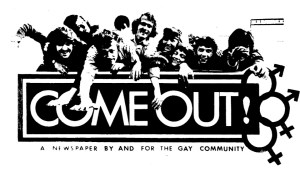
come out magazine masthead, 1969

Just to give you a sense of its tone, the first lines of the first issue proclaimed, “COME OUT FOR FREEDOM! COME OUT NOW! POWER TO THE PEOPLE! GAY POWER TO GAY PEOPLE! COME OUT OF THE CLOSET BEFORE THE DOOR IS NAILED SHUT!” Before gay liberation (as scholars John D’Emilio and George Chauncey have shown), coming out meant entering into the gay community, but the new metaphor of the closet turned “coming out” into a political act—and demanded a total re-evaluation of the quietly queer lives many gay men and lesbians had lived before.

The New York Public Library also has a wonderful online exhibition commemorating the 40th anniversary of the Stonewall Riot, with some beautiful images culled from their extensive archives, like this one of two members of the Gay Activists Alliance.

Rutgers University Gay Liberation Conference, April 30–May 2, 1971. Photograph by Kay Tobin Lahusen. NYPL, Manuscripts and Archives Division, Barbara Gittings and Kay Tobin Lahusen Gay History Papers and Photographs. Copyright Kay Tobin Lahusen. Digital ID: 1606088

A quick subject search their digital image gallery reveals much, much more, including this photograph by Diana Davies of the 1971 Gay Pride march, almost as exciting for its vintage fashion as the banner “Women’s liberation is a lesbian plot.” Think about that next Women’s History Month.

Christopher Street Liberation Day, June 20, 1971 [22]. Diana Davies, Stephen A. Schwarzman Building / Manuscripts and Archives Division, NYPL, Copyright Diana Davies, Digital ID: 1066141

That’s all for this week dear readers.

Historically yours,

Stephen
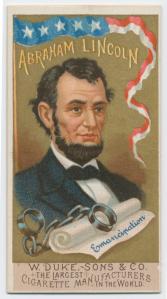
Abraham Lincoln Kitsch

Dear daydream believers,

You might have heard, say here, or here, or (shout-out to my adviser) here, that 2009 marks the bicentennial of the birth of Abraham Lincoln. And what better way to celebrate his memory than with Brown University’s enormous collection of “Lincolniana“—though I keep reading it as “Lincolnalia,”  suggesting both paraphernalia and a Victorian sexual pathology.

As it turns the 21st century has no monopoly on crass commercialization. See for instance this truly incredible advertisement from 1870, with the “Emancipation Proclamation” rolled up like cigarette paper, with the American flag waving above it like a trail of smoke.

Brown University, Center for Digital Initiatives

Yes America, you are free at last to smoke. And check out (in 3-D!!!) this delightfully kitschy 1950s Lincoln jug.

More genuinely moving is this beautiful 1904 silhouette portrait of the Great Emancipator beneath a tree.

Brown University, Center for Digital Initiatives

Though I have to say, my favorite portrayal of Lincoln appears in Behind the Scenes, the (mostly true?) memoir written by his Mary Todd Lincoln’s black dressmaker Elizabeth Keckley. As she tells it, President Abe was extremely fond of animals, especially his pet goats. “My pets recognize me. How earnestly they look!”  Read it on Google if you haven’t already!

Earnestly yours,

Stephen

P.S. Did you know you can become a fan of the “Young Abraham Lincoln” on Facebook? Find out what Joshua Speed saw in him!

Dear citizens of the land of nod,

Today’s entry comes to you courtesy of UC Santa Barbara’s fabulous Cylinder Preservation and Digitization Project–an archive of music from the early 20th century, when songs were recorded on hard wax cylinders. You could literally spend hours here building your ITunes playlist.

Just imagine wooing your sweetheart with such ethnically-sensitive tunes as Irving Berlin’s “Sweet Italian Love,” sung in dialect by the prolific vocalist Billy Murray. Looking forward to the lyrical ingenuity of “When the moon hits your eye,” Murray sings, “When you kiss-a your pet/And it’s-a like-a spagett/Dat’s Italian love!”

Of course, Italians aren’t the only ones who know how to set a romantic mood. Here Ada Jones sings “Hottentot Love Song,” about, you guessed it, a Hottentot man in love with a “Zulu maid.” As Jones croons, “If my skin ain’t white/I’ve a heart that’s white/and it’s all for you.” (You can view the sheet music here from Mississippi State University’s Templeton collection).

And last but not least, listen to Murray and Jones sing the anti-sentimental duet “Pet Names” from George Cohan’s 1908 musical, “The American Idea”–a “satire on international marriage,” in the words of the New York Times.

Be sure to check out the archive’s curated exhibits, too!

Until next time!

Yours romantically,

Stephen

Dear compatriots in soporific studies,

One drawback to working from home is that the couch always looks far more attractive than the computer screen. I find myself contemplating this dilemma today on the arrival of our long-awaited sofa, named by its manufacturers “Rachel,” not to mention our new platform bed, named “Elan.” That’s right, Rachel and Elan–what a lovely Jewish couple!

So in honor of the marriage of Rachel and Elan, I thought I’d point you today to a trio of films on home improvement, from the always astonishing Prelinger Archive–an online collection of ephemeral films.

In the first, from 1940, “Let Yourself Go,” we get a tour of a mattress store–a kind of proto-Sleepy’s–where everyday people try to find the secret to a good night’s rest. One man, for instance, has “been fighting his pillow for years,” the narrator says. “So far he’s lost every round.”

Let Yourself Go

In the second, from 1958, “Something New From Something Old,” a young couple named “Jack and Jill” turn their sad NYC tenement apartment into a luxurious haven, all to the tune of “Almost Like Falling in Love.”

Somethign New

But lest you remain unconvinced the importance of domestic improvement, watch this harrowing film from 1954, “The House in the Middle,” which shows how houses in various states of repair and disrepair would hold up under atomic attack. Because when the bomb drops, you’ll want your paint job to remain unblemished.

House in the Middle

Happy homemaking to all!

Yours in domestic bliss,

Stephen

To my fellow loafers,

Two more collections to bookmark today–both from the University of Washington’s digital archives.

In honor of the Jewish Day of Atonement this coming Monday, there’s the Washington State Jewish Archives, including 569 photographs, documenting the everyday life of the Evergreen state’s Jews from the 1890s to the 1990s. I can’t figure it out, but I kind of love this photograph of young people at Seattle’s Hebrew Immigrant Aid Society House. And for the holiday, take a journey back to Yom Kippur 1957, with this stagey photograph of some well-dressed (and tallis-ed) men of Congregation Ezra Bessaroth, showing off the synagogue’s Torah scrolls.

Little did those gentlemen know what the next decade had in store. Witness the U of W’s superb Vietnam War Era Ephemera Collection. Among the wide range of images are issues of the groovily-illustrated Seattle underground newspaper The Helix, as well as flyers from Seattle’s Young Socialist Alliance, like this one in support of the Black Panthers.

Have a great weekend!

Lazily yours,

Stephen

Dear Partners in Leisurely Labor,

For this entry, I want to highlight the digital collection at University of Maryland, a mid-size but nice to navigate site.

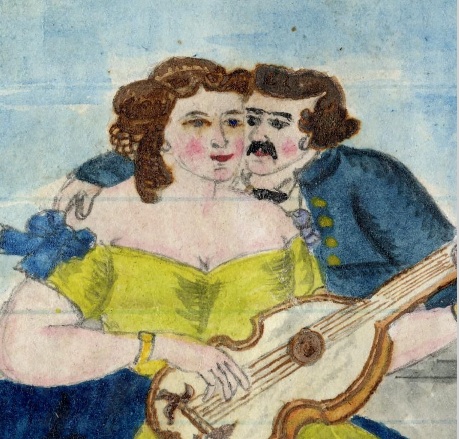
One of their newest additions is a book of drawings from a Confederate soldier who was imprisoned in a Union camp in Point Lookout, Maryland for the last year of the Civil War. The illustrations are oddly funny–almost like a Robert Crumb or Art Spiegelman comic. I’ve attached a close-up from one of my favorite drawings, called “A Prisoner’s Dream,” featuring an unusually buxom woman playing a mandolin. (Read whatever Freudian symbolism you’d like into that.)

University of Maryland Manuscripts, item 5213

The site also has a nice exhibit of World’s Fair imagery, searchable or organized by location. Journey back to a time when “The World of Tomorrow,” (Trylon and Perisphere included) was just one architect’s dream!

I will say the one singular disappointment of the U. of Maryland archive is that there Jim Henson collection is only viewable from their campus. Which just goes to show, sometimes you do have to leave your computer after all.

Lazily yours,

Stephen

Dear readers,

Who, or what, is the Lazy Scholar, you ask? I’ve been mulling for a few months now the idea of starting blog devoted to the ideal of scholarly sloth–doing as much research as humanly possible without actually leaving your computer. In all seriousness, I think that web archives are an incredible resource for  scholars and teachers–particularly as it grows increasingly difficult to pry computers out of the hands of most  undergraduates (and many graduate students, too). So, on with the entry:

Some of you may already have come across Duke Libraries’ impressive digital collection, though I hadn’t until a few weeks ago. Among the newest gems rests their “AdViews” collection, an iTunes-powered menagerie of TV commercials from the 1950s to the 1980s.

Among my favorites, these creepy Corn Flakes ads (link will launch in iTunes) and these minstrel-y Honeycomb ads (“Come to the Honeycomb Hideout!”). You should also check out their highlights.

Sugar Coated Corn Flaked

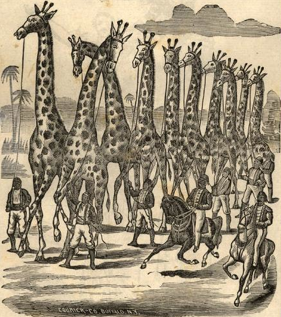
For those studying the years before the baby boom, there’s also their fabulous Emergence of Advertising in America, with illustrated ads from 1850 to 1920. The broadsides section not only includes ads for hardware (NAILS!) and railroad shows (GIRAFFES!), but also some placed by detective agencies (WANTED FOR RAPE!

Giraffes

This is only a small glimpse of their resources on advertising–and an even smaller glimpse of Duke’s overall digital resources. If anyone else skims the collection (or has used it before), it would be great to highlight some of their other collections. But for now, I’m back to work. And by work, I mean surfing the internet for other distractions.

Lazily yours,

Stephen